


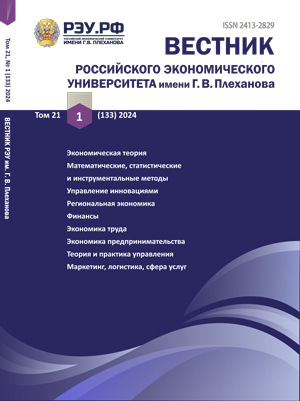
Scientific and practical peer-reviewed journal "Vestnik of the Plekhanov Russian University of Economics"
Founded in 2003.
The edition is reregistered in the Federal Service for communication, informational technologies and media control: PI N FS77-64709 dated 22 January 2016.
Periodicity: 6 issues a year
ISSN 2413-2829
The journal is included in the List of peer-reviewed scientific journals and publications of the Higher Attestation Board, publication in which is mandatory for defending
Doctorate and PhD dissertations.
The journal is included in the Russian index of scientific citingand presented at the platform of Scientific electronic library for registered users.
Current issue
ECONOMIC THEORY
The article analyzes such aspects as scales of global AI market, changing investment activities, AI use in practical work. It was pointed out that AI exerts serious impact on global transformation of economic processes, including technological modernization of real sector of economy, upgrading business-processes and shaping new models of interaction between market participants. The author studies key barriers in the field of AI introduction in practical activities and ways of their overcoming. At the same time aspects hindering introduction of AI technologies at enterprises of real sector of Russian economy were investigated. Serious attention should be paid to the fact that the primary objective in the field of applying technologies based on AI does not imply complete liberation of man and replacing him/her by AI technology but aims at making his/her work more effective and safe. As a result the research builds up a comprehensive idea how AI shapes a new economic landscape in the world and what aftereffects it could have on global economy in the long run.
MATHEMATIC, STATISTICAL AND INSTRUMENTAL METHODS
The article provides the author’s approach to getting comparable quantitative estimations of multi-dimensional index of economic prosperity in Russian regions taking into account specific features of standing and trends of regional development. Index was built by the method of factor analysis done on the basis of statistic data aggregated for the long period from 1955 to 2022. This solution gives an opportunity not only to minimize the impact of random fluctuations in economy on weighted factors of indicators but also to eliminate correlation links between indicator components, which helps overcome consequences of multi-collinearity effect typical of social and economic indicators. Estimated values of index converted into response variable, where ‘1’ is given to regions with the level of economic prosperity higher than average one in Russia and ‘0’ – in the opposite case were included as a resultant variable in the classification model of random forest trained on panel data for the whole concerned period with regard to fixed effect. On the preliminary stage of the research clusterization of entities was carried out by the level of their demographic development. The obtained cluster marks were converted into a set of binary variables, which helped cut the number of included in the model of panel data dummy variables used for modeling fixed effects. Age-specific births were used in this model as explanatory variable. As a result of building up the model by Russian regions for the period from 1955 to 2022 potential estimations of sensitivity of the multi-dimensional index of economic prosperity to changes in demographic processes in Russian regions with regard to specific features and current conditions of their development were obtained and analyzed.
The article deals with the acute task of searching for early indicators of volatility on Russian derivatives market in conditions of its structural transformation and unprecedented growth in private investors’ activity. It was pointed out that classical approaches to forecasting based on retrospective price data usually ignore a rich informational layer located in behavior of different groups of market participants. The goal of the research is to verify econometrically the hypothesis that behavioral patterns, in particular aggressive positioning of retail investors, can have predictive power for future market instability. The research is based on analyzing official data of the Moscow Exchange on open positions in future contracts on Gasprom shares for the period 2020–2025. The paper put forward and tested methodology of building two original behavioral indicators: index of consensus (orientation) and index of confidence (intensity). With the help of Greinger test on causality and building regressive ARMAX models the link between these indicators and RVI volatility index was identified and estimated quantitatively. The key result is empiric confirmation of the fact that rising confidence index of retail investors act as statistically important early signal for successive growth in volatility with the time lag of 3–4 weeks. The obtained findings are statistically sustainable and allow us to characterize retail investors as instability predictors in contrast to institutional participants, who more often respond to completed changes. The proposed indicator could be used for developing systems of early warning of growing market risks.
INNOVATION MANAGEMENT
The article studies innovation approach to resolving acute problems of customs administration in the field of highlytechnological import. The authors focus on difficulties arising in controlling supply of components for renewable power sources and power-efficient equipment, which are characterized by growing volumes and increasing time of customs clearance. As a tool for overcoming structural and bureaucratic barriers the authors proposed a detailed model of specialized hackathon. This format is considered as a platform for open inter-sectoral cooperation among customs bodies, young IT-specialists and industry experts aimed at joint development of practical program solutions. By analyzing statistical data and regulation and legal base economic effect of introducing results of such steps was evaluated. The research substantiated that implementation of the proposed model could cause serious reduction in time of customs clearance and development of a new personnel profile ‘customs data engineer’. Practical importance of the research implies elaboration of concrete organizational and methodological recommendations on hackathon conducting that can be used by state bodies to optimize customs control over strategically important product groups and stimulate digital transformation of customs service.
Digital products are characterized by fast scalability, continuous renewal and close dependence on users’ data. Such features cause high uncertainty, which requires a new approach to administration that could respond quickly to changes in demand, technological shifts and development of business-models. Research topicality is stipulated by the necessity to work out models that can adequately demonstrate the development of digital products in conditions of high changeability. The goal of the research is to elaborate an integrated model of digital product life cycle administration, which can combine the classical eight-stage model with principles of non-linear development borrowed from the theory of organization life cycle. Research methodology is based on systematic literature review, comparative analysis and conceptual modeling. Research findings show that the proposed model covers all stages of digital product life cycle, from the idea and concept to development, testing, launch, active growth, maturity, slump and withdrawal from market. Special attention is paid to scenario deviations, such as concept alteration, re-launch, integration, repeated growth and controlled completion, which can adapt model to conditions of unstable environment. Practical importance of the model implies its usage for strategic planning and optimizing managerial solutions, as well as possibility to forecast risks and transitions from one phase to another. Research restriction is connected with its conceptual nature, which requires further empiric validation and elaboration of quantitative methods of scenario transition evaluation. Future investigations can aim at adaptation of the model to different branches of digital economy and study of the impact of institutional factors on dynamics of digital product life cycle.
REGIONAL ECONOMY
Today economy is transforming very fast by passing to information-innovation model. This transition is accompanied by deep changes in approaches to economic activity management focusing on shaping strategic innovation potential. The goal of the research is to elaborate and substantiate methodology of evaluating innovation potential of cluster structures and verify possibilities of its practical application. Methodological base of the research is formed by complex inter-disciplinary approach that gave an opportunity to work out methodology acting as a systemic platform made for effective adaptation of innovation activities to changing conditions of external economic environment on the basis of getting strategically important analytical information. Its foundation is made up by methodology of expert survey and methods of economic and mathematic modeling, which together form an integrated model of analytical strateging of innovation development, including qualitative estimations in combination with quantitative forecasts that can form preconditions for developing strategic solutions on the level of cluster policy. Empiric data obtained during methodology testing was used as material for the research. Results of the research can be used in the process of evaluating innovation potential of cluster structures in conditions of strategic planning and strategic management of innovation clusters. The proposed approach can adequately describe innovation potential of cluster structures, which allowed us to recommend it for practical use in the field of finance and economic, as well as in organizational and strategic analysis connected with functioning of cluster innovation associations.
Regional heterogeneity of industrial development in the Russian Federation hinders the process of finding strategic priorities and objective estimation of efficiency of industrial policy steps. Comparative analysis on the regional level is necessary for efficient management of industrial development, as it helps identify the relative position of each region in the respective rating and investigate structure of its competitive advantages and drawbacks. The goal of the research is to work out and test methods of complex estimation of industrial development of Russian Federation entities on the basis of the integral index and regional rating process. Finally, the rating consisting of 82 regions by sub-indexes and the integral index was formed. In the top section of the integral rating you can see the Republic of Tatarstan (1), the Moscow region (2), the Chukotskiy autonomous area (3), Moscow (4) and St. Petersburg (5). In the bottom section of the rating you can see the Jewish autonomous area (82), the Republic of North Osetia – Alania (81) and the Republic of Kalmykia (80). It was shown that leadership of regions is formed by various combinations of sub-indexes (well-balanced ‘complex leaders’, leaders by certain trends, regions of catching-up growth), which can extend analytical opportunities for address industrial policy.
The article investigates opportunities to strengthen interaction of BRICS member-states by optimizing transport corridors. The authors analyze the current problems of integration and put forward ways of raising efficiency of transportation and communication infrastructure of Russian regions participating in international cooperation. To estimate potential of transport cooperation EDAS (Evaluation Based on Distance from Average Solution) method acute in the academic environment was used. This tool gives an opportunity to compare variants of solution and to choose the most efficient trends for further development of integration in concerned projects. On the basis of investigations a map of possible partner interaction was worked out, which shows priority routes and initiatives for strengthening cooperation inside the BRICS group. It can help member-states of the organization use efficiently current opportunities and compensate for weaknesses of each other. The authors came to the conclusion about importance of coordinating efforts of BRICS member-states in developing joint infrastructure, training qualified personnel and introducing advanced technologies, which could bring synergy effect in the future and foster strengthening of economic links within the frames of the organization and on the global level.
The article researches spatial shifts in the system of sea cargo traffic in Russia, which become evident in redistribution of transport activity among sea basins, changes in the structure of goods being transported and increase in infrastructural load on certain lines. The goal of the research is to identify spatial and structural changes in sea cargo traffic in Russia, estimate role of certain basins in redistribution of transport activity and find restrictions of aggregated statistical indicators in analyzing today’s shifts in sea logistics. Methodological base of the research is formed by systemic approach to analysis of sea activities. The investigation used methods of comparative and structural analysis of statistical data, indicator grouping and analytical interpretation of spatial shifts in the system of sea cargo traffic. It was found out that redistribution of transport activities in favor of south and east lines is observed in the system of sea cargo traffic in Russia. It was shown that maintaining high aggregate volumes of cargo turnover does not rule out changes in spatial structure of transportation and increasing infrastructural loads of certain basins. Conclusion was drawn that aggregated cargo turnover indicators are insufficient for analyzing spatial changes in sea logistics. Importance of cargo traffic analysis grows as it takes into account transportation lines, infrastructural tie-up, structure of cargo being carried and degree of transport activity concentration.
The article deals with the development of tools to shape economic potential in region in conditions, when the majority of academic works focus on its statistical estimation but not on processes of arising and growing. Topicality of passing from measuring methods to purposeful designing of economic potential of region was substantiated. Leaning on model of the viable system, three functions of system formation were identified, i. e. diagnostics, activization and management. On the basis of bibliometric analysis methodological approaches were systematized: resource, resultant, reproductive, institutional, innovative-technological, synergetic, adaptive-resilient, systemic, structural, integral and program-targeted that were grouped by two axes– substantial (what is being formed) and methodological (how study and management are organized), which helped link each approach to concrete tools. As a result of research findings synthesis tools of shaping economic potential of region were worked out, where methods of latent reserve activization, mechanisms of synergy stimulation, strategic planning, resilience tools, project methods and adaptive methodology were distributed by functions of shaping and sub-groups of approaches to shaping economic potential of region. Such synthesis can create an integrated system that provides controllable growth and qualitative reforming of the regional economy ability to develop. The obtained results form a methodological foundation for operationalization of shaping economic potential of region and could act as a basis for the development of regional strategies.
FINANCE
The article analyzes the impact of artificial business splitting on key stakeholders. Special attention was paid to the role of stockholders as important concerned parties who can prevent splitting scheme realization. The authors study potential of multi-voting shares as a corporate tool of counteraction against business splitting and investigate grounds of different groups of investors – retail and of three categories of institutional (venture) – in preventing such schemes. Limits of using multi-voting shares for these targets were identified. A conclusion was made that on the current stage multi-voting shares should be considered as a promising tool to prevent business splitting on corporate level, as they can foster issuer tax discipline maintenance.
Global processes of digital transformation of economy stipulate change in the paradigm of tax administration. Today’s approach to tax control evolves from reactive response to pro-active model based on principles of permanence and prevention. Despite availability of a large volume of research in the field of digitalization of tax systems, the issue of differentiation of concrete impact channels of digital technologies on mechanisms of tax control realization is insufficiently studied. The goal of the research is to analyze the impact of economy digitalization on current practice of tax control in order to design the system of principles for its realization, identification of channels of digital transformation impact on control procedures and substantiation of criteria for evaluation of their efficiency. The article found out principles of tax control realization with identification of positive and adverse aftereffects and demonstration of cumulative effect in view of criteria estimation of these factors efficiency. Methodological basis of the research incorporates the sum total of academic methods of cognition, including induction, generalization, systematization and grouping. To build matrix and visual presentation of results the method of structural and logic modeling was used. Findings of the research can be used by tax bodies to develop strategies of communicative interaction with business representatives to build constructive system of digital confidence in respect of current tax control realization.
The article studies acute issues of behavioral finance development in conditions of high volatility on stock market in Russia. Study of behavioral anomalies and behavioral effects in the context of this young branch of finance science is connected with the objective necessity to use heuristic analysis. High market risks and limited rationality require extra tools for finance analyst, such as research of behavioral effects. On the basis of investigating specific features of behavioral finance on home stock market the author’s classification of behavioral anomalies was put forward. As a classifying factor it was proposed to use the source of the present anomaly arising, according to which it was necessary to identify cognitive and emotional features of the investing entity, market anomalies and anomalies stipulated by social effects. By analyzing Russian stock market the author showed mechanism of behavioral effect impact on dynamics of market share price of Russian companies. Characteristics of behavioral effects was provided, which can influence efficiency of securities operations and analysis of their nature in view of their impact on finance flows was given. This approach helped provide concrete recommendations on blocking behavioral effects both for professional traders and individual investors.
The article shows results of the experiment demonstrating interdependence of random value changes – market share prices of public companies – and close to zero correlation. For the experiment three pairs of Russian public stock companies were chosen with positive, negative and close to zero coefficients of correlation of market share prices for 24 months, from September 1, 2023 to August 1, 2025. Interdependence of share price changes remained with correlation coefficient close to zero. Findings of the experiment can be interesting for qualified investors therefore they are presented for inter-disciplinary discussion.
The problem of ambivalence of inflation expectations is considered as one of essential indicators of macro-economic stability and efficiency of monetary-credit policy. In conditions of unpredictability of inflation processes and limited finance literacy of the population this topic becomes extremely important for the development of monitoring tools and regulative measures. The research studies the link between level of finance literacy and shaping inflation expectations within the frames of login-regression. It was found out that expectations concerning price dynamics depend on respondents’ age and education level and it was also revealed that population finance literacy can influence customer decisions and behavior of market entities.
The goal of the research is to develop mechanism of credit system (CS) functioning in Russia. The research hypothesis assumes that the mechanism of CS functioning is determined by relations among its components. Research methodology was made by method of analogies and u-sin pentagram. As a result in CS of Russia five system-forming components were identified: lending, accumulating, advancing, redistribution and stimulation. Components are put in order of their formation. The designed model shows relations of mutual support and mutual limits among identified components. The author put forward the approach to management of functioning and developing credit system of Russia based on regulation of resource flowing among components, inter-component relations of support and contradictions among its components. Results of researching CS of Russia can be used in elaborating the concept of its formation and development management and in designing the program of its development with regard to concrete conditions, targets and objectives.
ECONOMICS OF LABOUR
The article deals with the problem that became topical lately and that impacts education and prospects of future generations in the country. While developing different forms of education, in particular, company-sponsored education such important aspects as market conditions in regions, enterprise resources and society development in general are not taken into account. It could cause misunderstanding and refusal to interact among parties of the process. Company-sponsored quota means training of specialists oriented to concrete industries and institutions. Apart from that, real possibilities of enterprises, their personnel potential and resources are not always taken into consideration. The example of the Orlov State Institute of Culture shows indicators characterizing changes affecting company-sponsored education in University of creative specialization and problems leading to decreasing interest in this type of education. Therefore, to extend possibilities of company-sponsored education close interaction between education institutions and enterprises is necessary, as well as timely informing the latter about changes, taking into account their real needs and resources, which could return the system of company-sponsored education and provide industry with qualified personnel.
ECONOMICS OF ENTREPRENEURSHIP
The article analyzes transformation of state finance support to industrial entities of small and medium business (SMB) in Russia in conditions of two successive macro-economic shocks, i.e. COVID-19 pandemic and increase in sanction restrictions. Empiric basis of the research is formed by a block of information about facts of provided support measures, which were grouped by types of tools (returnable and non-returnable), level of administration (federal and regional) and implementation operators (bodies of executive power and development institutions). The research showed that during the sharp period of crisis the importance of federal channel increases as a mechanism of scalability and unification of access conditions, while regional level retains key role in measures requiring due account of territorial specificity and development priorities. It was found out that stabilizing function of support in majority of cases is connected with the rising role of non-returnable tools, while restoration and adaptation one – with credit and guarantee mechanism. The author showed the increasing role of development nstitutions that provide returnable tools, mainly guarantees. At the same time on the regional level the importance of micro-financial organizations is still high. Academic novelty of the research implies comparative analysis of the mechanism of SMB finance support in conditions of two crisis periods within the frames of a single time interval and structural decomposition of identified changes by levels of administration, tools and implementation operators. The obtained findings can be used for upgrading the mechanism of coordinating federal and regional support measures and adjustment of tools meant for industrial SMB support.
For the last 1.5 decades the attitude to entrepreneurship in Russian society seriously changed, especially in youth environment, where it is more and more often considered as an appealing form of employment. The article highlighted the connection of deep-rooted entrepreneurial culture and new labour ethics based on values of freedom, flexibility, work-life balance, comfortable working conditions and creative self-realization. In spite of high level of entrepreneurial intentions and activities of students the quality side of their motivation is still low. Students’ wish to work in business is explained not by interest in innovation activity as it is (positive, voluntary entrepreneurship) but by the intention to avoid traditional wage employment, subordination and unstable income, which is characterized as enforced entrepreneurship. Results of the survey of 300 students of social and humanitarian profile at the Plekhanov Russian University of Economics showed that 57.9% of respondents regarded entrepreneurship as future work. Key grounds are high income (76.6%), flexible work schedule (61.3%) and possibility to avoid subordination to bosses (54.8%). Social (14.9%) and innovation (15.7%) reasons move to the background. Therefore technological and social business-models are not in demand with students: they prefer creative (38.7%) and classical (36.8%) models. It means dominance in the youth environment of replicable entrepreneurship, i. e. reproduction of existing products and business-models. The author underlined the necessity to shift focus from quantitative growth of entrepreneurial initiatives to their qualitative improvement through introduction into the youth environment values of the long-term strategic outlook, social responsibility and technological leadership.
The goal of the research is to develop and approve models of estimating risks arising in implementing microenterprises business-models in conditions of economy of data. The article proposed to delimit classical entrepreneurial risks and specific risks caused by digital transformation. It was shown that in line with traditional categories (operational, finance, market, personnel) for micro-enterprises risks of losing communication channels, dependence on suppliers and absence of digital analysis can become rather serious. On the basis of multiplicative formula “possibility x damage” risk matrix for 4 types of business-models, such as traditional off-line model, platform, data-oriented and hybrid one was built. Approval on real cases showed that the highest integral risk is typical of platform model, while the lowest one – for data-oriented model. Conclusion was drawn that digital integration itself cannot cut risks, if it is not accompanied by the development of internal analytical competences and diversification channels. Practical importance of the research implies the opportunity to use matrix for express-selfdiagnostics of micro-enterprises.
In today's world, digital transformation has ceased to be a task of technological modernization and is increasingly becoming a factor determining the sustainability and manageability of organizations. Despite the active implementation of digital solutions, a significant number of projects fail to achieve the expected results, which is due not to technical limitations but to internal organizational and cognitive barriers. This paper highlights a key problem: the cognitive-temporal gap, which manifests itself in the discrepancy between the speed of technological change and an organization's ability to comprehend and practically master it. This gap is exacerbated by the fragmentation of interactions between functional units and differences in the operational logic of IT structures and business units. Based on an analysis of the implementation of digital solutions in a government technical institution, an organizational mechanism for integrating digital transformation and sustainable development has been developed. It is based on a cyclical management framework, stable cross-functional teams, and a built-in system for supporting staff cognitive adaptation. Test results show that the proposed approach reduces transaction costs, shortens administrative process processing times, and increases employee engagement in digital change. Furthermore, it demonstrates a shift toward a more sustainable organizational development model based on continuous learning and the coordination of management decisions.
THEORY AND PRACTICE OF MANAGEMENT
The article deals with the process of shaping civilization consciousness of Russian students in conditions of modernizing state policy aimed at strengthening traditional spiritual and ethical values. In context of searching for sovereign ideological model civilization approach is considered as a methodological basis to construct the image of future Russia. Introduction of a new subject ‘Principles of Russian State System’ into the curriculum of higher education acts as a key tool of translating these values to new generations. Sociological survey of students of the Plekhanov Russian University of Economics showed dialectical tension between state demand for ideals of collectivism and service to Motherland and ideas of individual self-realization and personal success deep-rooted in youth’s minds. Analysis of value priorities showed that students prefer universal humanitarian principles (humanism, justice) to specific national or statecraft principles. Special attention is paid to identifying contradiction between traditional value-orientation and preparedness to active participation in innovation work. The authors came to the conclusion that mere introduction of traditional values into the current world outlook paradigm is not enough for their absorption by young people. More flexible and dialectic approach is necessary, which could integrate tradition and modernization and demonstrate that values do not oppose technological progress but fix ethical frames and sense landmarks for it. Practical importance of the research deals with designing of recommendations needed for efficient education policy taking into account the actual youth’s consciousness and necessity to work out conditions for natural perception of values through dialogue and compliance of declared values with real social practice.
The article elaborated integral risk-index of informal company groups used for de-facto integrated corporate entities in FMCG sector. The research difficulty implies the fact that factual managerial integrity of company group does not often concur with its juridical structure: control, finance flows, operational decisions and digital data are distributed among several independent legal entities. In such cases traditional approaches to risk assessment based on analyzing separate organization cannot allow us to find aggregate vulnerability of corporate architecture. The goal of the research is to substantiate index model connected with legal, tax, operational, financial and digital risk contours. Research methodology covers systemic analysis, risk-oriented modeling, standardization of particular indicators, scenario estimation and formalization of risk-corrected managerial usefulness. R_NKO=Ew_jP_jS_jD-j model was put forward, which aggregated possibility, consequence toughness and insufficiency of control with due regard to weight of certain risk-contours. Model data showed that tax and legal shocks can transfer informal group from zone of controlled risk to zone of intense control; in this case introduction of digital and compliance-contours reduces the integral risk indicator. Scientific novelty implies transfer of analysis from legal form of holding to factual architecture of managerial links. Practical importance of the model gives a possibility to use it in diagnostics of informal company groups, working out corporate contracts, adjustment of in-company control, assessment of subsidiary responsibility and projecting digital monitoring.
The article systematized economic research concerning the issue of expat community economy in two aspects: impact channels (cash remittances, direct and portfolio investment; knowledge, innovation and entrepreneurship) and policy of voluntary return. Analysis is based on standardized block of 4 948 publications in the period from 1970 to 2025 that covers 623 journals. In descriptive and empiric works we can observe stable links: cash remittances correspond to a drop in poverty indicators and a rise in private investment of households; expat community networks – to increase in export and possibility of direct foreign investment; academic and business communities of migrants – to publication and paten activity and company setting-up. In terms of state policy the following practices were generalized: regulation of legal status, conditions of entry and stay, tax regulation, academic and business treks and reintegration services. Statistic data show the return program effect; options of effect amounts are connected with the character of measures and institutional parameters of their implementation. The provided structure helps compare programs by indicators of return and retention, employment, innovation activities and raising investment and identify trends, where more strict cause estimations are necessary, as well as more complete and comparable statistic base.
MARKETING, LOGISTICS, SERVICE SECTOR
The article studies specific features, indentifies regularities, develops communication campaign of the brand with use of social media on market of sports goods. The notion ‘communication campaign’ was researched, key communication trends of sports industry brands were provided, communication types were identified, trends of communication process development in sports brands were shown and features and preferences of their target audience were demonstrated. The author analyzed experience of introducing communications with use of social media in practice of sports brands, carried out complex diagnostic of their SMM-activity and content marketing, identified specific features of communication and interaction with customers of target groups. And finally conclusions and provisions were given that stipulate topicality of further research of the subject concerning the use of social media and digital-tools in communication campaigns.

ISSN 2587-9251 (Online)


